NZ shares in an SMSF: which credits count in Australia, and which never will
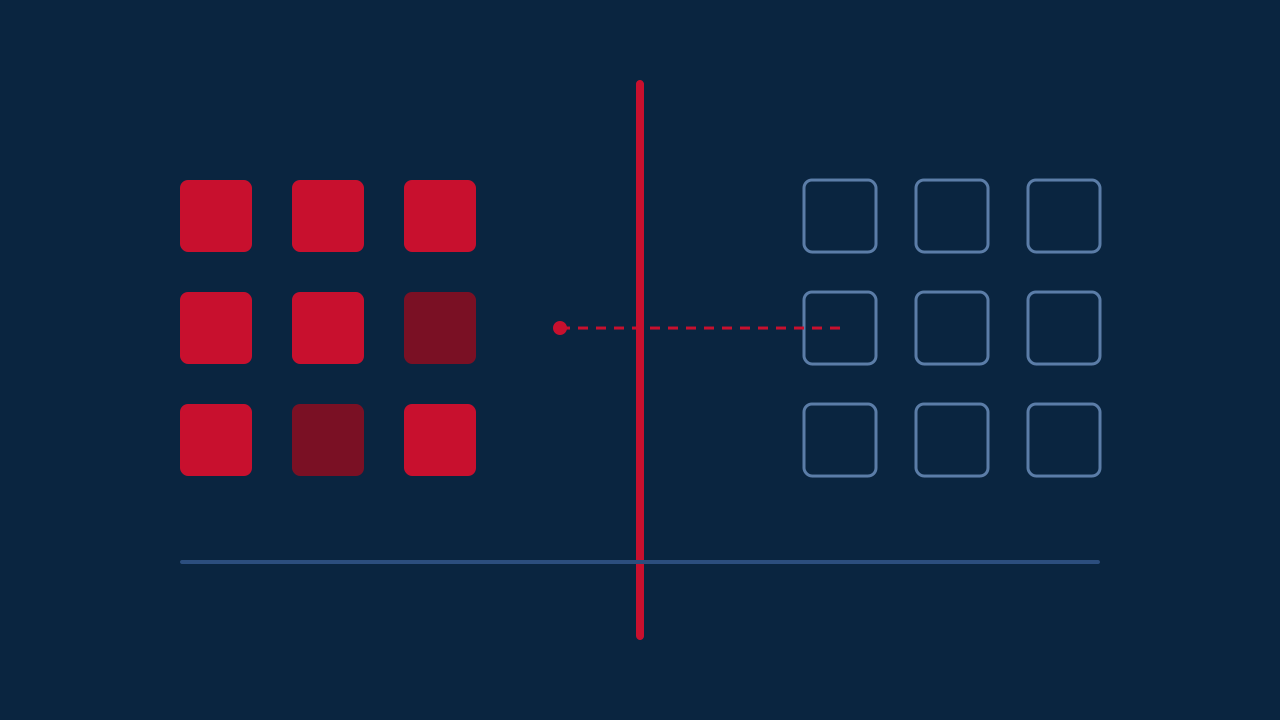
Plenty of Australian funds hold shares in companies that straddle the Tasman: dual-listed banks, NZ-headquartered companies on the ASX, Australian companies with deep NZ operations. The dividend statements those companies produce carry two different kinds of credit, and Australian tax law treats them in exactly opposite ways.
Getting the boundary wrong costs in both directions. Claim the wrong kind and the return is over-stated. Ignore the right kind and the fund leaves a legitimate offset unclaimed.
The kind that counts
Under the trans-Tasman imputation rules, a New Zealand company can elect to join the Australian imputation system and attach Australian franking credits to its dividends. Where that has happened, an Australian shareholder receives a dividend with genuine Australian franking attached, and the ordinary Division 207 machinery applies: the credit grosses up assessable income and generates a tax offset, subject to the same holding-period and qualified-person tests as any other franked dividend.
So a fund holding shares in an NZ company that has made the election is not holding an exotic asset. It is holding a franked dividend stream with one extra wrinkle: the franking sits alongside a New Zealand credit that looks similar on the statement and behaves nothing alike in the return.
One genuine trap inside the good news: where a New Zealand company also pays a supplementary dividend and the fund claims a foreign income tax offset for NZ withholding tax, the franking offset is reduced under section 220-400. The statement will not do that arithmetic for you.
The kind that never counts
New Zealand imputation credits are the mirror image. They are real credits in the New Zealand system, they appear prominently on distribution statements, and they are never claimable in Australia. Not partially, not with an election, not for any entity type. In an Australian return they are informational only.
This is stated plainly in ATO guidance, and it is still one of the most repeated trans-Tasman errors, for an understandable reason: the statement presents both credit types with similar prominence, and nothing on the document says which legal system each one belongs to.
Why statements make this harder than it should be
A trans-Tasman dividend statement is written to satisfy two tax systems at once. It reports Australian franking (if the company has elected in), New Zealand imputation, possibly NZ non-resident withholding tax, and possibly a supplementary dividend, all in adjacent columns. The trustee's job at return time is to keep four adjacent numbers in four different buckets, once a year, from memory.
Software does not have a memory problem. When we built the trans-Tasman handling in SMSF Core, the design decision was to show the rejected credit rather than hide it: the NZ imputation figure appears in the fund's records marked as informational only, not claimable in Australia, with the ATO reference alongside. The point is that an auditor reviewing the file can see the credit was considered and excluded on purpose, rather than wondering whether it was missed.
The one-line version
Australian franking on an NZ company's dividend: real, claimable, subject to the usual 45-day and qualified-person tests. New Zealand imputation credits: never claimable in Australia, in any amount, by any Australian fund. If a statement shows both, they belong in different buckets, and the records should show both the claim and the exclusion.
General information only, and trans-Tasman holdings are exactly the kind of area where a fund's own numbers deserve a check against the current ATO guidance.
Sources
- Income Tax Assessment Act 1997 (Cth) ss 220-400, 220-405, NZ franking company rules
- ATO QC 50645, trans-Tasman imputation
- Income Tax Assessment Act 1997 (Cth) Division 207, franking credit gross-up and offset
SMSF Core is live. Start SMSF Core → See pricing →
Not a licensed financial service. Information only.