Payday Super is live. Two things can bite an SMSF this month, and one is your bank account
Payday Super commenced on 1 July. Most of the coverage speaks to employers, reasonably, since they carry the deadline: super guarantee must now reach the employee's fund within seven business days of each payday, and the penalties for missing it are not tax deductible and can apply per payday. A weekly payroll is fifty-two chances a year to get it wrong.
But roughly 244,000 SMSFs receive employer contributions for about 366,000 members, and on the receiving side two things deserve attention this month.
1. Your fund's bank account has a new job requirement
Employer contributions under Payday Super flow through modern payment rails, and the money has to land inside the seven business days. That works when the SMSF's bank account is NPP enabled, the New Payments Platform behind near-real-time transfers. Plenty of long-running SMSF accounts, especially older cash management accounts, are not.
The check takes a minute: ask your bank whether the fund's account receives NPP payments, or look for PayID support in the account's features. If it does not, the fix is opening or switching to an account that does, and updating the details your employer holds. Doing this in July beats discovering it when a contribution bounces in August.
2. July can deliver a double-up, and the cap does not care why
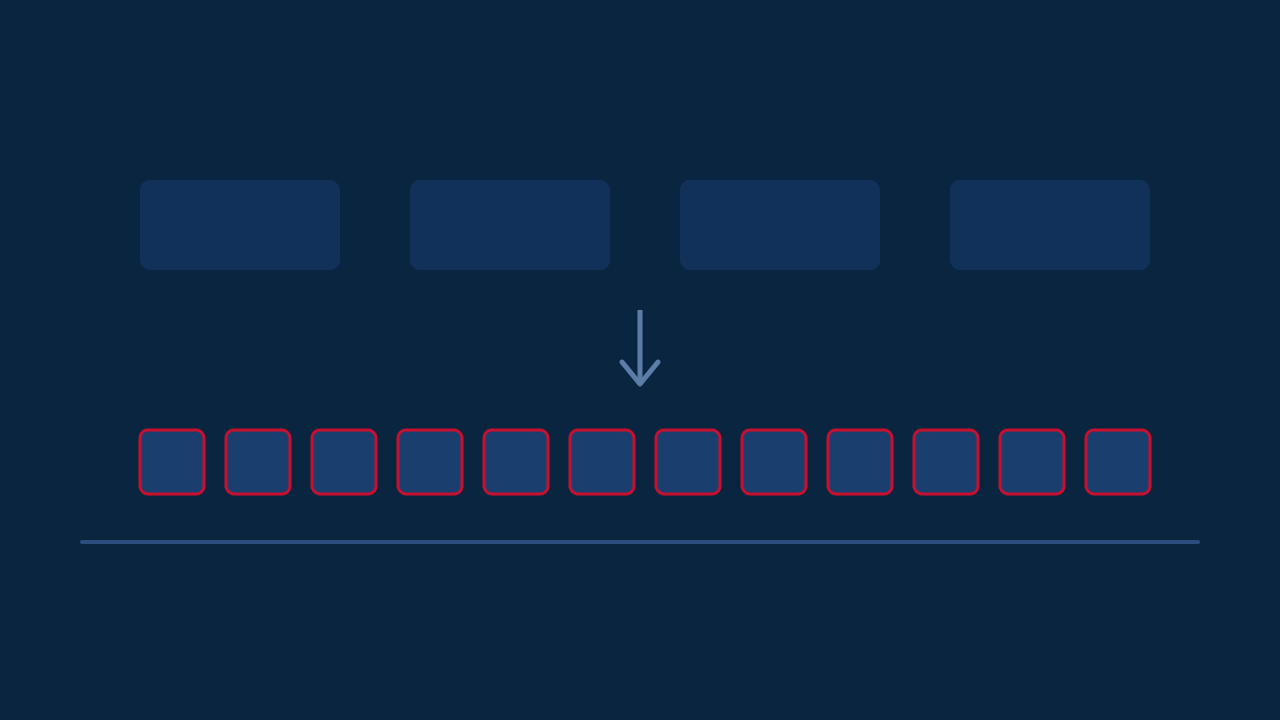
The transition creates a one-off pile-up. The final quarterly contribution for April to June lands in July under the old timetable, and the first Payday Super contributions for July's paydays land in the same month under the new one. Two regimes, one month, both counting toward the same concessional cap.
The cap this year is $32,500. For most members the July double-up is absorbed without drama. For members who salary sacrifice close to the cap, or whose employer pays a June quarter catch-up late, the transition month can consume cap room that the rest of the year was counting on. The Government has indicated relief for transition-driven breaches, and the detail of that relief is worth confirming with your accountant rather than assumed.
The practical habit that makes this a non-event is simply watching the running total. Contributions now arrive in small frequent amounts rather than four lumps, which means a fund's contribution records change shape: more rows, smaller figures, and a total that creeps rather than jumps. Checking the position once a quarter used to be enough because the money moved once a quarter. It moves every payday now.
What this looks like in practice
An SMSF member on a fortnightly payroll will see twenty-six employer contributions this year where they used to see four. Each one should appear in the fund's records with its date and amount, and the running concessional total should be visible at a glance rather than reconstructed in May.
SMSF Core's caps tracker does exactly that arithmetic: contributions recorded as they land, each member's position against the $32,500 cap updated with every entry, and carry-forward amounts from prior years in the same view. The July double-up shows up as what it is, two identifiable payments, rather than a mystery total at year end.
There is a sample fund at app.smsfcore.com/demo. Payday Super pacing, built specifically for these contribution windows, is included in SMSF Core and live now. Start at app.smsfcore.com.
SMSF Core is an information tool, not a licensed financial service. Talk to a licensed adviser or your accountant about your own position.
Sources
- ATO, About Payday Super (employer obligations from 1 July 2026)
- Treasury Laws Amendment (Payday Superannuation) Act, SG timing rules
- ATO key superannuation rates and thresholds, concessional cap FY 2026-27
SMSF Core is live. Start SMSF Core → See pricing →
Not a licensed financial service. Information only.