SMSF legacy pensions can be fully commuted until 6 December 2029. Four facts decide what the exit costs
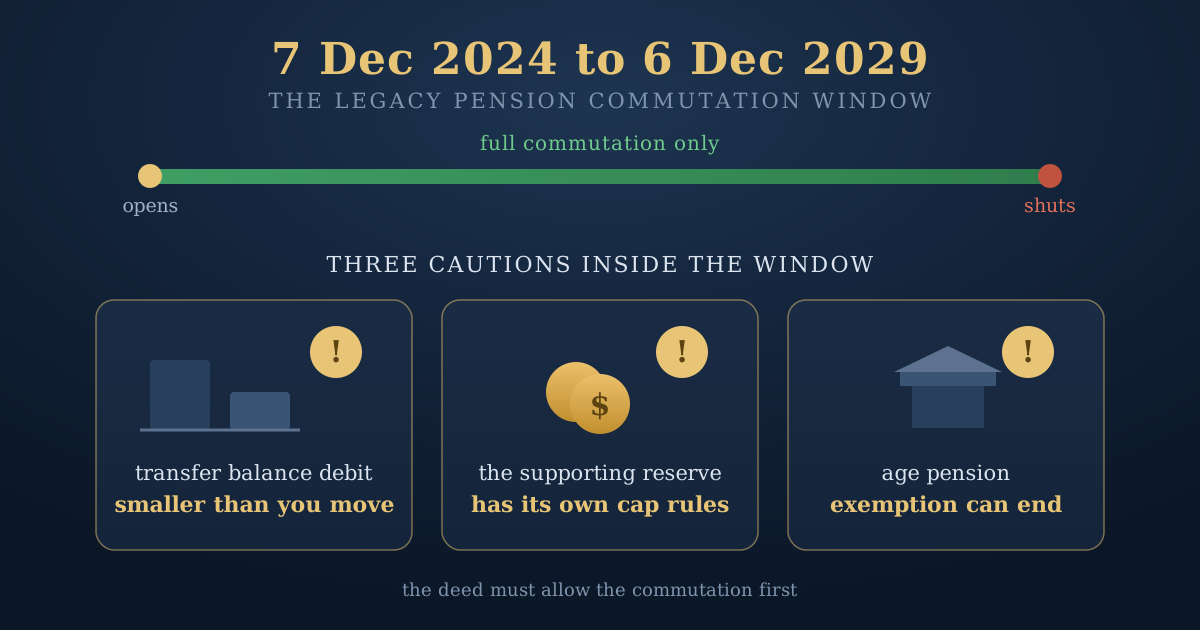
For nearly twenty years, a market-linked, lifetime or life-expectancy pension inside an SMSF was close to a one-way door. The pension standards made these products non-commutable except in narrow circumstances, so a trustee who started one in the early 2000s was largely stuck with it, along with whatever reserve was sitting behind it. A regulation that commenced on 7 December 2024 changed that. There is now a five-year period, ending 6 December 2029, in which these legacy pensions can be fully commuted. The catch is that commuting is not a single clean action. Four separate rules decide what the exit actually costs, and three of them can bite after the money has already moved.
Which pensions the window covers
The relief applies to the three legacy income streams that meet the old pension standards in the Superannuation Industry (Supervision) Regulations: complying lifetime pensions (subreg 1.06(2)), life-expectancy pensions (subreg 1.06(7)), and market-linked or term-allocated pensions (subreg 1.06(8)). Most of them commenced before 20 September 2007, or were started by converting an earlier product from before that date, but the ATO is explicit that the regulation itself sets no commencement cut-off. Ordinary account-based pensions are not legacy products and were never caught by the lock, so nothing here applies to them.
Two limits matter before anything else. The change relaxes the pension standards; it does not rewrite your trust deed or fund rules. The ATO's own examples have the trustee amending the fund rules first and the member commuting after. If the deed does not permit a commutation of the legacy pension, that has to be fixed before the pension is touched. And for lifetime pensions the concession covers products paid by an SMSF, a small APRA fund, or a fund that is not a defined benefit fund, so a lifetime pension paid by a defined benefit fund sits outside it.
The window is full commutation, not a trim
The relief is all or nothing within the period. A partial commutation of a legacy pension does not qualify; the product has to be commuted in full. Once it is, the resulting capital can start a new retirement-phase income stream if there is transfer balance cap room, sit in an accumulation account, or leave super as a lump sum, subject to the caps and to a member's own preservation position. The five-year clock is the only deadline that is fixed. Miss 6 December 2029 and the relaxed standard lapses, leaving the old non-commutable rules in place.
Fact one: the transfer balance debit can be smaller than the balance you move
This is the trap that surprises trustees who assume the transfer balance account nets to zero. Lifetime pensions, and market-linked and life-expectancy pensions that existed before 1 July 2017, are capped defined-benefit income streams. When one is commuted, the debit to the transfer balance account is not the amount actually moving. It starts from the special value that was credited when the transfer balance cap system began, less any earlier debits. For market-linked and life-expectancy pensions the ATO then also subtracts the pension payments received in the years before the commutation year, and the greater of the payments made and the minimum required in the commutation year. That arithmetic can leave the debit well below the current account balance.
The ATO's own worked example makes the gap concrete. A market-linked pension with a special value of $1.6 million on 1 July 2017 is commuted in January 2025 after $600,000 of payments in the earlier years and a $35,000 pro-rata minimum in the commutation year. The debit is $965,000, leaving $635,000 sitting in the transfer balance account. Roll the $1 million account balance into a fresh account-based pension and the credit is the full $1 million, which in that example pushes the member $35,000 over their personal cap. The general transfer balance cap indexed to $2.1 million on 1 July 2026, and personal caps differ; we set out how at smsfcore.com/blog/personal-transfer-balance-cap-indexation-2026. The debit figure is knowable in advance from the fund's transfer balance account reporting, and it is the number to check before deciding where the commuted capital goes.
Fact two: the supporting reserve has its own cap rules
Many legacy pensions, particularly complying lifetime pensions, are backed by a reserve built up to fund the promised payments. What happens to that reserve on commutation is governed by its own part of the 2024 regulation, and the treatment splits in two. Where the reserve is a pension reserve supporting the income stream being commuted, and the allocation is made for the person who was receiving that pension because they were its recipient, the allocation is excluded from the non-concessional cap and does not count towards the concessional cap either. The ATO calls this an excluded cessation allocation, and it is the pathway the regulation was written to open. It does not apply where the commutation results from the death of the primary beneficiary.
Other reserve allocations are treated differently. Allocations that used to count against the concessional cap now count against the non-concessional cap instead, unless they fall inside one of the specified exclusions, such as a fair and reasonable allocation to all members that stays under 5 percent of the member's interest. For a member already near their non-concessional limit, or one whose total super balance has switched their bring-forward off, an allocation from the wrong reserve, or to the wrong person, can create excess non-concessional contributions rather than a tidy transfer. Treating the reserve as a rounding line on the commutation is how members back into that excess. It carries a contribution question with a member attached, and it needs its own working before the pension is unwound.
Fact three: an age pension can change the day the exemption ends
Some legacy pensions, especially the older complying lifetime and life-expectancy products, carried a Centrelink asset-test exemption of 50 or 100 percent depending on the product and when it started. Commuting the pension ends that exemption, and the capital that was partly or wholly outside the assets test becomes assessable. For a member receiving an age pension, that can reduce or stop the payment going forward.
There is relief on one edge of this. Commuting an asset-test-exempt pension used to risk a retrospective debt for exemptions already received. The Social Security (Waiver of Debts - Legacy Product Conversions) Specification 2025, in force from 28 March 2025, provides for that historical debt to be waived where the commutation follows the super rules, so the past is not clawed back. The prospective change is not waived. The asset counts from the day the exemption ends, and Services Australia assesses it on its own rules and timing, so a member who relies on the age pension needs that assessable figure in hand while the decision is still open.
Why this is back on the table in 2026
Two things brought a decade-old lock back into live conversation this year. Division 296, the additional 15 percent tax on the share of earnings attributable to a total super balance above $3 million, is now law and applies from 1 July 2026, and the same law changes how total super balance is defined. Members holding legacy products have gone back to look at what they are actually carrying. The free estimator at smsfcore.com/div296 works from a recorded balance. Alongside it, income from capped defined-benefit pensions above the defined benefit income cap, which is the general transfer balance cap divided by 16, or $131,250 for 2026-27, is partly assessable in a way ordinary account-based pension income is not. Neither of those is a reason to commute on its own. Both are reasons the number is worth knowing while the window is open.
What we track
SMSF Core carries each member's transfer balance account as a running figure, so the debit that would arise on commuting a capped defined-benefit pension is visible against the personal cap before any decision is made, not reconstructed afterwards. It holds the fund's reserves as their own tracked balances with the member each allocation would attach to, and it keeps every member's total super balance against the thresholds it gates, which we set out at smsfcore.com/blog/smsf-total-super-balance-30-june-thresholds. There is a sample fund at app.smsfcore.com/demo with the pension and reserve records populated.
Dates, thresholds and product eligibility above were read from the ATO and the Federal Register of Legislation on 14 September 2026 and can change. Whether commuting a particular legacy pension suits a fund turns on facts this article cannot see, including each member's transfer balance history, the reserve behind the pension, and any Centrelink entitlement, which Services Australia assesses separately. SMSF Core is an information tool, not a licensed financial service. Talk to a licensed adviser or your accountant before acting.
Sources
- Treasury Laws Amendment (Legacy Retirement Product Commutations and Reserves) Regulations 2024 (Cth) (F2024L01596), Federal Register of Legislation: made 5 December 2024, registered 6 December 2024, in force from 7 December 2024 (register entry checked 14 September 2026)
- ATO, Relaxed commutation rules for legacy retirement products (QC 105078, last updated 26 June 2025): five-year period 7 December 2024 to 6 December 2029, eligible products by SISR subregulation, full commutation, fund rules must permit, transfer balance and social security consequences (checked 14 September 2026)
- ATO, Transfer balance cap: capped defined benefit income streams (last updated 24 July 2025): which products are capped defined benefit income streams, the debit calculation on commutation of a legacy product, and the worked commutation example (checked 14 September 2026)
- ATO, Changes to reserve allocations (published 18 June 2025): capped allocations count towards the non-concessional cap from 7 December 2024; excluded cessation allocation from a pension reserve to the former recipient (checked 14 September 2026)
- ATO, Key superannuation rates and thresholds, Transfer balance cap (QC 18123, last updated 27 April 2026): general transfer balance cap $2.1 million and defined benefit income cap $131,250 for 2026-27 (checked 14 September 2026)
- ATO, Better targeted superannuation concessions (QC 105024, last updated 7 July 2026): Division 296 is law, applies from 1 July 2026, large super balance threshold $3 million for 2026-27 (checked 14 September 2026)
- Social Security (Waiver of Debts - Legacy Product Conversions) Specification 2025 (Cth) (F2025L00454), Federal Register of Legislation: in force from 28 March 2025 (register entry checked 14 September 2026)
SMSF Core is live. Start SMSF Core → See pricing →
Not a licensed financial service. Information only.