Since 2023 every SMSF reports transfer balance events quarterly. The September quarter is due 28 October
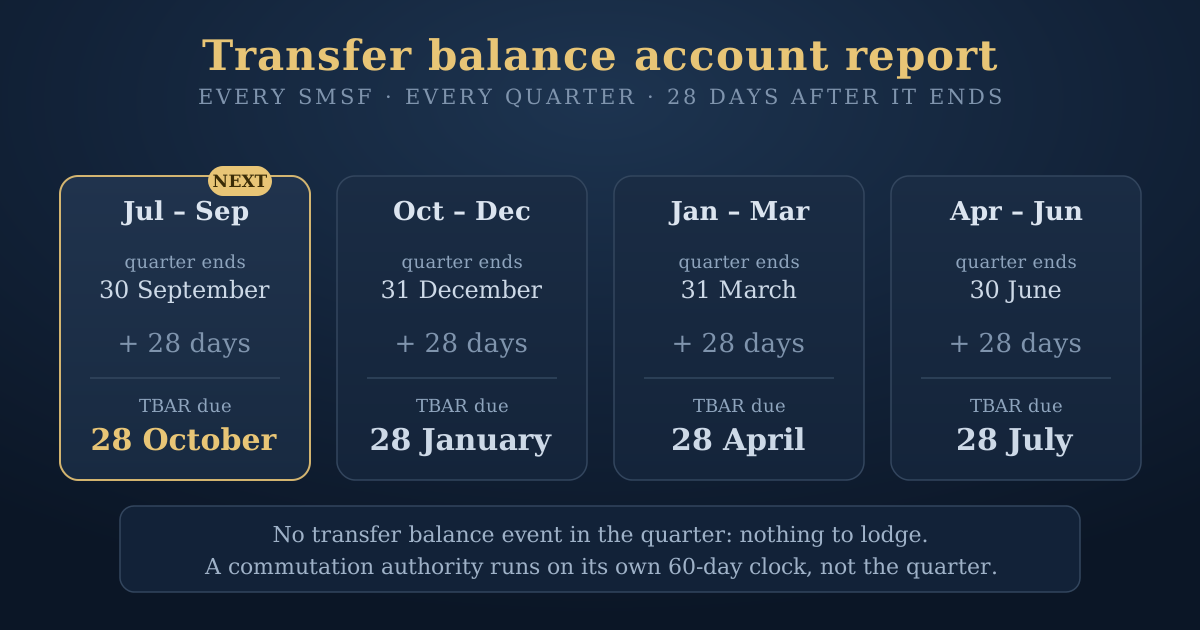
Since 1 July 2023, every self-managed super fund reports transfer balance events on the same quarterly cycle, no matter how large or small its members' balances are. The old concession that let a fund report once a year is gone. For an event that happens in the July to September quarter, the transfer balance account report is due by 28 October, which for the current year means 28 October 2026.
That is the deadline most likely to be missed, because nothing on a bank statement or a contract note tells a trustee it exists. The report is triggered by pension mechanics, not by money moving, and the fund that starts a first pension in September owes a report in October whether or not anyone drew a cent from it.
What changed on 1 July 2023
Before that date, a fund whose members all had a total super balance under $1 million could lodge its transfer balance account report annually, alongside the SMSF annual return. Funds with any member at or above $1 million reported quarterly. That split was an administrative concession, and the ATO removed it from 1 July 2023.
Now the rule is one line: all SMSFs report quarterly, and the total super balance of the members no longer changes the frequency. A fund with two members on modest balances is on the same 28-day clock as a fund with a member near the cap.
The four dates
The report is due 28 days after the end of the quarter in which the event occurred. The four deadlines are fixed:
- Events in the July to September quarter: due 28 October
- Events in the October to December quarter: due 28 January
- Events in the January to March quarter: due 28 April
- Events in the April to June quarter: due 28 July
The date that matters is when the event happened, not when the fund got around to processing it. A pension that commenced on 20 September sits in the September quarter and is due by 28 October, even if the paperwork was signed in October.
What counts as a reportable event
A transfer balance account event is one that creates a credit or a debit in a member's transfer balance account, the running total the ATO keeps against the general transfer balance cap. For 2026-27 that cap is $2.1 million, and we set out how the indexation actually reaches members at smsfcore.com/blog/personal-transfer-balance-cap-indexation-2026.
The events an SMSF reports include:
- The commencement of a member's first retirement phase income stream, which puts a credit in the account
- The full or partial commutation of a retirement phase pension, which puts a debit in
- A limited recourse borrowing arrangement payment, where the arrangement was entered into or refinanced from 1 July 2017 and the payment increases the value of the interest supporting a retirement phase income stream
- A personal injury, or structured settlement, contribution
- An income stream stopping being in the retirement phase, for example because it failed to meet the pension standards for the year
Commutations are the ones trustees underestimate. Any time a pension is partly commuted back to accumulation, or a lump sum is taken by commuting rather than as a pension payment, that is a debit event and it has to be reported. A fund that runs a legacy pension through the commutation window has an event to report too, and we cover that window at smsfcore.com/blog/smsf-legacy-pension-commutation-window.
What you do not report
Plenty of activity inside a pension is not a transfer balance event, and reporting it anyway just adds noise. You do not report:
- Regular pension payments, the periodic income the member draws
- Investment earnings or losses on the assets backing the pension
- An income stream that simply runs out because the account has been exhausted by payments, expenses and losses, rather than being commuted
- The death of a member as an event in its own right
Death needs a word of its own. Where a pension reverts automatically to a surviving beneficiary, the death itself is not reported, but a credit arises in the reversionary beneficiary's transfer balance account and that credit is reported. The distinction catches funds because the trigger is the reversion, not the death certificate.
The 60-day exception
One event does not wait for the quarter. When the ATO issues a commutation authority, usually because a member has exceeded their transfer balance cap and been told to commute the excess, the fund must respond within 60 days of the date the authority was issued. That clock runs independently of the quarterly cycle, and missing it can leave the member's pension non-compliant. If a commutation authority lands, treat the 60 days as the real deadline and the quarterly report as secondary.
How it is lodged
A trustee can lodge the report through Online services for business, and events lodged that way are generally processed within about a day. A registered agent can lodge on the fund's behalf, and there is a paper form, the Transfer balance account report (NAT 74923), which takes up to four events for the same member per report. There is no separate annual reconciliation for an SMSF: the quarterly reports are the reporting.
If no transfer balance event happened in a quarter, there is nothing to lodge for that quarter. The obligation is event-driven, so a fund in steady state can go quarters without a report and then owe one the moment a pension starts, a lump sum is commuted, or a commutation authority arrives.
What we track
SMSF Core keeps each member's transfer balance events as they happen and maps them to the quarter they fall in, so the 28-day deadline is visible before it passes rather than after. Pension commencements, commutations and the reversionary credits that follow a death are flagged as reportable, and the routine pension payments that are not events stay out of the way. There is a sample fund at app.smsfcore.com/demo with the events and the quarterly due dates populated.
SMSF Core is an information tool, not a licensed financial service. Whether a particular event is reportable, and by when, turns on facts this article cannot see. Talk to a licensed adviser or your accountant before acting.
Sources
- ATO, When to lodge a transfer balance account report for SMSFs (all SMSFs report quarterly from 1 July 2023 regardless of members' total super balance; report within 28 days after the end of the quarter in which the event occurred; no event means no lodgement). Read 29 September 2026.
- ATO, Super transfer balance account report instructions, When to lodge and What needs to be reported (events that give rise to a credit or debit; commutation authority responses due within 60 days of issue). Read 29 September 2026.
- ATO, Super transfer balance account report instructions, Reporting methods (forms) and lodgment (Online services for business, registered agent, and the paper report NAT 74923; up to four events per member on a paper report). Read 29 September 2026.
SMSF Core is live. Start SMSF Core → See pricing →
Not a licensed financial service. Information only.