The work test moved off your SMSF in 2022. To deduct a contribution after 67, it still applies to you
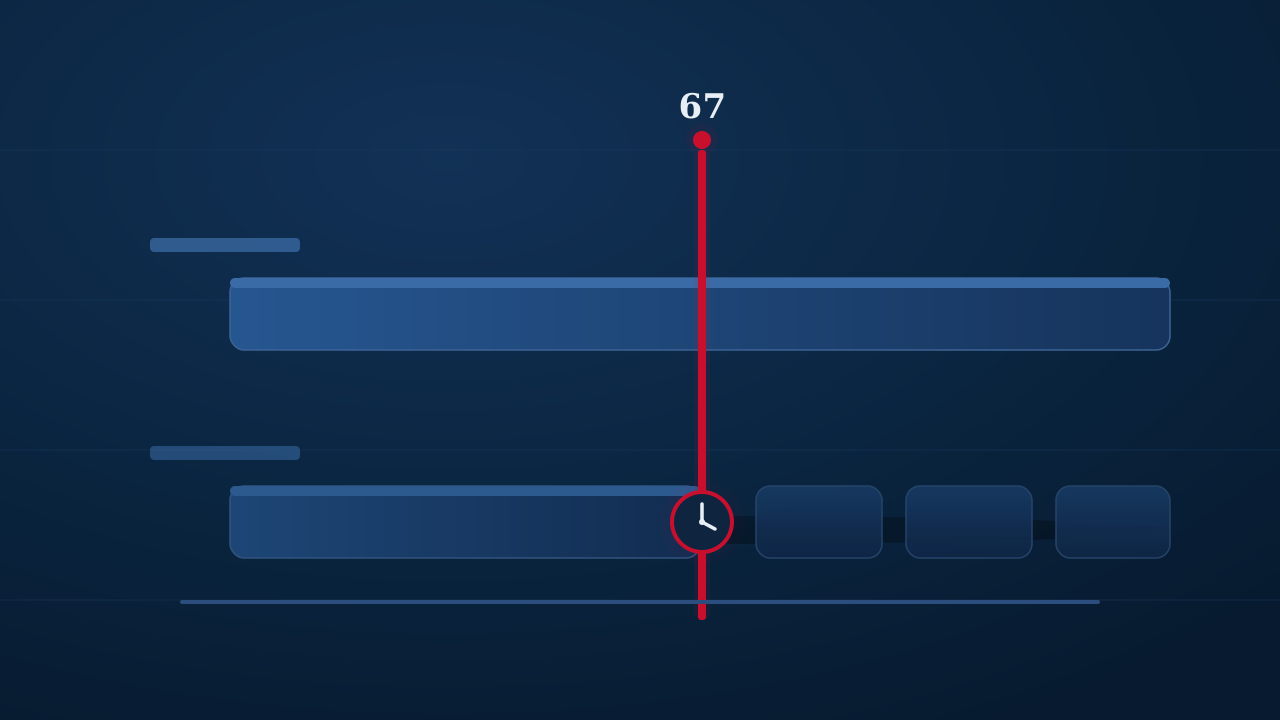
Two things used to happen at the same moment when an older member put money into a self-managed fund. The trustee checked the member had worked, and the deduction followed. On 1 July 2022 those two things came apart, and most trustees only meet the gap when a deduction they assumed was fine gets queried.
Here is the split as it stands for the 2026-27 year. A fund can accept a member's personal contribution up to age 75 without asking whether they worked a single hour. Whether the member can then deduct that contribution is a separate question, answered on the member's own tax return, and after 67 it still turns on the work test.
The two gates that used to be one
Before July 2022 the work test lived in the fund's acceptance rules. If a member aged 67 to 74 wanted to make a voluntary contribution, the trustee had to be satisfied the member had been gainfully employed for at least 40 hours in a 30-day stretch during that financial year before the fund could take the money. The test sat with the trustee, at the point of contribution.
That acceptance-side test was removed. Under the current fund acceptance rules in SIS regulation 7.04, a trustee can accept employer and member contributions, personal, salary sacrifice or after-tax, for any member under 75. The trustee no longer asks about work at the door. The only age line left on the acceptance side is the 75th birthday: a voluntary contribution has to reach the fund no later than 28 days after the end of the month in which the member turns 75, and after that the fund can accept only mandated employer contributions and downsizer contributions.
The work test itself did not go anywhere. It moved into the income tax law, as a condition of claiming a deduction rather than a condition of the fund accepting the contribution. So a member can pay $20,000 into their fund at 69, have the fund accept it without question, and then find at tax time that they cannot deduct it because they did no qualifying work that year. The money is in the fund either way. Only the deduction is gated.
What the work test is, in the year of the contribution
To deduct a personal contribution made from the day you turn 67 until 28 days after the end of the month you turn 75, you need to have been gainfully employed for at least 40 hours over any 30 consecutive days in the same financial year the contribution was made. Gainfully employed means employed or self-employed for gain or reward in any business, trade, profession, vocation, calling, occupation or employment. Unpaid work does not count, and neither does passive income such as interest, dividends, trust distributions or rent.
It is an annual test tied to the income year, not a rolling one. Forty hours banked in a single month satisfies it for contributions made anywhere in that year, before or after the hours were worked. A contribution made after the 28-day window following your 75th birthday month cannot be deducted at all, whatever work you did.
The exemption is a one-time key
There is a way to deduct a contribution after 67 in a year you did not work, but it can be used once and it is narrow. The work test exemption applies where all of these hold: you met the work test in the financial year immediately before the contribution year, your total super balance was under $300,000 at the end of that prior year, you have not deducted a contribution under the exemption in any earlier year, and no fund accepted a contribution for you under the old acceptance-side exemption in any earlier year either.
That $300,000 figure is a total super balance measured at 30 June, across every fund you hold, not just the self-managed one. The same 30 June balance drives several other rules, and we set out how it gates them at smsfcore.com/blog/smsf-total-super-balance-30-june-thresholds. Because the exemption is spent on first use, the year it is used is a decision worth recording, not one to discover after the fact.
The notice of intent is where the trustee still touches this
The deduction is claimed by the member, but it does not work without a step that runs through the fund. To deduct a personal contribution the member must give the trustee a valid notice of intent to claim, in the approved form, and receive the trustee's acknowledgement. The notice has to be given by the earlier of the day the member lodges that year's tax return and the last day of the following financial year. It is not valid if, by the time it is given, the fund no longer holds the contribution or has started paying a pension based on it, and a partial rollover or withdrawal in between limits how much of the contribution a valid notice can cover. Miss the timing and the deduction is lost even if every other condition is met.
For a self-managed fund the trustee and the member are usually the same people, which is exactly why this step gets skipped. The acknowledgement is still a document the fund has to produce and keep, and it is one of the records that supports the contribution's treatment in the fund's own return.
The cap has not moved out of the way
A deductible personal contribution is a concessional contribution, so it counts against the $32,500 concessional cap for 2026-27 alongside any employer amounts. If the cap is already full from super guarantee, a further personal contribution can still be made, but a contribution that is not deducted is a non-concessional contribution, and one that is deducted over the cap is an excess concessional contribution that is taxed at the member's marginal rate and counts toward the non-concessional cap unless it is released. Unused cap from earlier years can lift the ceiling where a member's total super balance was under $500,000 at the prior 30 June; the mechanics are at smsfcore.com/blog/carry-forward-concessional-cap-fy2026-27.
What we built for it
SMSF Core records each member's contributions against the concessional cap for 2026-27 as they land, and keeps the two documents this rule depends on in one place: the notice of intent and its acknowledgement, and the member's own record of how the work test or the exemption was met. Because the fund now accepts the contribution while the member carries the deduction evidence, those records sit on different sides of the same event, and the tracker holds both. Every figure cites the ATO source it came from. There is a sample fund at app.smsfcore.com/demo if you want to see it with data already in it.
Whether a particular member meets the work test or qualifies for the exemption depends on facts this article cannot see, including balances held in other funds. SMSF Core is an information tool, not a licensed financial service. Talk to a licensed adviser or your accountant before acting.
Sources
- ATO, Accepting contributions (SMSF), QC 23325, last updated 19 March 2026 (checked 14 September 2026)
- ATO, Restrictions on voluntary contributions, QC 73089, last updated 24 July 2025 (checked 14 September 2026)
- ATO, Personal super contributions, QC 23225, and Notice of intent to claim or vary a deduction, instructions (checked 14 September 2026)
- ATO, Contributions caps, key superannuation rates and thresholds FY 2026-27, QC 18123, last updated 11 September 2026 (checked 14 September 2026)
- Income Tax Assessment Act 1997 (Cth) s 290-165 (age-related conditions) and s 290-170 (notice of intent), as modified by F2023L00564 (checked on the ATO Legal database 14 September 2026)
- Superannuation Industry (Supervision) Regulations 1994 (Cth) reg 7.04 (acceptance of contributions), table as substituted from 1 January 2023 (checked on the ATO Legal database 14 September 2026)
SMSF Core is live. Start SMSF Core → See pricing →
Not a licensed financial service. Information only.